E-Bike Range: Plan Your Round-Trip Commute
Plan an e-bike commute around the complete round trip and your riding conditions—not the largest mileage printed on a product page. Check how the manufacturer obtained its range figure, then compare the route, assistance, load and charging access with your own needs. A maximum range claim is a reference point; it does not guarantee that every rider can cover that distance.

What does “up to 80 miles” actually tell you?
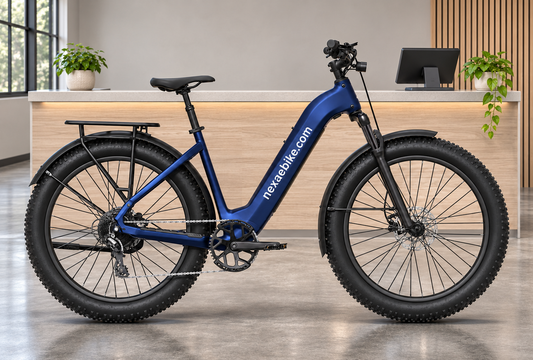
The Discover 3, referenced by our 750W, 730Wh step-through commuter listing, provides a useful example. Its manufacturer lists 80 miles of pedal-assist range and 65 miles of throttle range. The speed-and-range section states a 187-pound rider, Eco mode and flat roads. These are manufacturer figures, not NexaEbike road-test results. Read the manufacturer's current specifications.
That short footnote does not provide a complete repeatable test protocol: it does not establish the precise wind, temperature, tire pressure or riding speed for your journey. Ask for clarification when a purchasing decision depends on reproducing the maximum figure. Do not interpret the pedal-assist number as a promise for continuous throttle use.
Build a route budget before a battery budget
Start with where you actually need to go. Include the return journey, routine stops and an alternative route if your usual path is unavailable. For example, a hypothetical 9-mile trip to work plus 9 miles home and a 2-mile errand is 20 miles of planned travel. That arithmetic describes the route; it does not prove that a particular bike will complete it.
| Route detail | What to record | Buying implication |
|---|---|---|
| Complete distance | Outbound, return, errands and plausible detours | Compare the whole day, not just the trip to work. |
| Climbs and surfaces | Where the climbs occur; paved versus rough sections | A flat-road maximum is an incomplete comparison. |
| Wind and stops | Exposed sections and frequent intersections | Allow for conditions that differ between morning and evening. |
| Riding style and load | Preferred assist, pace, rider and luggage weight | Seek evidence relevant to how you will ride. |
| Charging access | Permission, suitable location, compatible charger and available time | An unconfirmed outlet is not a dependable return-trip plan. |
PEGASUS's explanation of its Bosch range calculator identifies total weight, riding mode, terrain, surface, wind and stop frequency as relevant inputs. This is useful guidance on what to investigate, but that calculator's motor and battery selections do not validate a Discover 3 range prediction. See the calculator's stated inputs.

Check sizes and current options
Match the bike to the commute, then check the practical details
Our listed Discover 3 combines a 730Wh battery with a 750W nominal motor, torque and cadence sensing, eight-speed gearing, hydraulic disc brakes, an air-suspension fork and a suspension seatpost. These details help you compare the overall commuting package. They do not turn battery capacity into a guaranteed number of miles.
A route with reliable charging at its destination presents a different planning problem from an all-day ride without power access. Before depending on destination charging, confirm the arrangement and follow the bicycle's charging instructions. Use the specified compatible charger; a matching-looking plug is insufficient. Our charger and battery-access guide covers those checks.
If capacity is the main comparison between two bikes, use watt-hours alongside the riding conditions and complete bike specification. See our single- versus dual-battery guide. Neither a larger pack nor a second battery removes the need to plan the return trip.
Establish your own route evidence gradually
Begin with a shorter familiar ride that leaves convenient ways home. Record the distance, starting and ending battery indication, assist setting, load and conditions. Repeat under representative circumstances before committing to a longer trip without charging. This produces evidence about your route rather than a universal mileage claim.
Keep room for unexpected travel and changing conditions. There is no single reserve percentage established here for every rider and route. Do not assume that a battery percentage display translates linearly into remaining miles, or that the energy used outbound will exactly match the return. If you cannot establish a comfortable margin, shorten the route, arrange verified charging or choose another transport option for that trip.

Frequently asked questions
Will an 80-mile e-bike cover my 40-mile round trip?
The headline alone cannot answer that. Compare the manufacturer's conditions with your route and obtain representative riding evidence before relying on the bike for the full trip.
Can I divide battery watt-hours by motor watts to find range?
That calculation does not yield miles. Nominal motor power is not a constant record of battery consumption throughout a ride, and distance also requires knowing how the bike is ridden.
Should I count on charging at work?
Only after confirming permission, a suitable location, the correct charger and sufficient time under the manufacturer's instructions. Have a return plan if charging is unavailable that day.
Where should I start comparing models?
Bring your route notes to the commuter e-bike collection. Compare fit, battery access, assistance controls and service needs alongside the range information.
Product and source information checked October 30, 2026. Manufacturer claims are attributed above; no independent range test was performed for this guide.
Tags:
Previous
Step-Through E-Bike Fit: Inseam, Stand-Over & Saddle Height
Next
E-Bike Test Ride: A Practical Comparison Checklist
Related articles

Electric Trike Beginner Mode: A Buying Checklist
Nov 04 2026

E-Bike Maintenance Records: Build a Service Log
Nov 03 2026

E-Bike Price Tracking: Compare the Same Variant
Nov 02 2026