E-Bike Fork Preload vs Lockout: Know the Controls
Fork preload and lockout serve different purposes. Preload concerns the spring's initial compression; lockout changes how freely the fork compresses. Before turning a dial on an e-bike, identify the exact fork and match its controls to the supplied instructions. Dial color, position and the word “hydraulic” are not enough to identify every adjustment.
This buyer's guide focuses on understanding the controls and getting a useful handover. It does not prescribe a universal pressure, number of turns or internal repair procedure.

Explore the Cranberry step-through e-bike
Three terms to separate before buying
| Term | What to establish | What not to assume |
|---|---|---|
| Preload | Whether the fork has an adjustable spring-preload control and how its manual identifies it | That the dial is an air valve or a lockout switch |
| Lockout | Which setting restricts compression and which permits normal movement | That every fork becomes completely rigid or has identical controls |
| Air pressure | Whether this exact fork has an air spring, and which pressure instructions apply | That every suspension fork needs a shock pump |
As an illustration of terminology, SR SUNTOUR's damping glossary lists hydraulic lockout, compression and rebound functions separately, with different combinations across its products. Those examples explain why names matter; they are not instructions or a component specification for the bike shown here.
What the Nomad 2 example actually documents
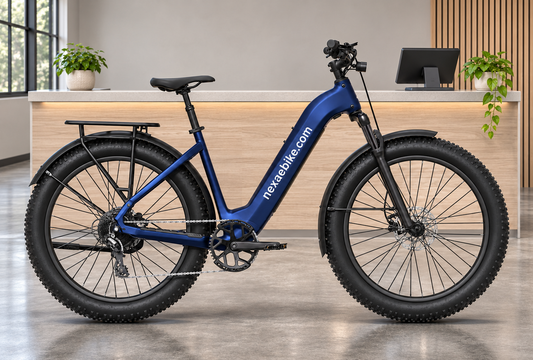
The Cranberry step-through fat tire e-bike, product reference Velotric Nomad 2, is listed with a 100mm front suspension fork, a suspension seatpost and 26 × 4-inch tires. Its owner's manual, printed page 47, discusses preload and lock/unlock controls and advises using a qualified mechanic when the appropriate preload is unclear.
Use that page alongside the actual supplied fork. Ask the seller to point out each control and demonstrate its function while the bike is stationary. If a diagram, label or explanation does not match the hardware, resolve the mismatch before adjusting it. This article does not turn that diagram into universal clockwise/anticlockwise instructions.

Explore the Cranberry step-through e-bike
A useful handover checklist
- Identify: record the fork's model or identifying label and the applicable manual version.
- Locate: have each user control identified on the actual bicycle, including the open and restricted-compression settings where fitted.
- Establish a baseline: record the setup demonstrated for you, using the manufacturer's approved method. Do not invent a starting point by forcing a dial against its stop.
- Compare consistently: for a permitted test ride, keep the route, tire pressure and carried items consistent so a change in ride feel is easier to interpret. Stop before making further adjustments.
- Know the service contact: ask who can check a fork that feels stuck, behaves differently from the demonstration or has a damaged control.
SR SUNTOUR's support guidance defines sag as the initial suspension compression with the rider and riding equipment on the bike. It also directs riders with reduced fork performance to a bicycle retailer for diagnosis. Sag targets and service schedules remain specific to the equipment; its numerical recommendations should not be transferred to an unidentified fork.
Match the question to your riding scenario
Mostly smooth commuting: ask whether the fork has a lockout or firm setting, what it does and when the maker permits its use. Do not assume a locked setting produces a measurable range improvement.
Mixed pavement: ask how to recognize the normal open setting and obtain a setup demonstration for your riding equipment and intended use. Compare comfort on an appropriate test route, not by judging the number of knobs.
Comparing an air-spring model: use our air-suspension commuter guide for the separate questions about the correct pump and pressure reference. For a repeatable comparison, use the e-bike test-ride checklist.

Explore the Cranberry step-through e-bike
FAQ
Does increasing preload increase the bike's load rating?
No. Treat suspension setup and permitted load as separate checks. An adjustment is not authorization to exceed the applicable bicycle, rider or component limits. If published load specifications disagree, obtain model-specific clarification instead of using the fork adjustment to justify the load.
Does “hydraulic fork” mean I should add air?
No. Hydraulic terminology does not by itself identify an air spring. Confirm the exact fork's design and instructions before buying a pump or attempting a pressure adjustment.
Can I use another bike's dial instructions?
Only use instructions confirmed for your equipment. Similar-looking knobs can control different functions; an online photo or AI illustration is not a substitute for the actual component label and manual.
What if the fork stays stiff?
Check the documented control setting while stationary. If its behavior remains unexpected, arrange a qualified inspection. Avoid using force or opening the fork to diagnose it from a general buying guide.
Sources reviewed October 30, 2026. The Nomad 2 support page displays an update of February 27, 2026; the cited SR SUNTOUR pages are undated. This is an equipment-identification guide, not a claim of a new launch or increasing search volume. We have not independently ride-tested the setup.
Tags:
Previous
E-Bike Serial Numbers: Your Ownership Record Checklist
Next
E-Bike Error Codes: What to Record Before Calling Support
Related articles

Electric Trike Beginner Mode: A Buying Checklist
Nov 04 2026

E-Bike Maintenance Records: Build a Service Log
Nov 03 2026

E-Bike Price Tracking: Compare the Same Variant
Nov 02 2026