Commuter E-Bike Guide: Fat Tires, Step-Through & Suspension
The right commuter e-bike starts with your route and daily handling needs. A step-through frame can make frequent stops easier; wide tires add volume for uneven surfaces; suspension addresses bumps. These features can work together, but they solve different problems. Start with fit, storage and road conditions before comparing motor numbers.
This guide compares three currently listed NexaEbike models using their published specifications. It is a specification-based buying guide, not a hands-on road test. Product availability and specifications can change.

Why comfort deserves a place on your commuter shortlist
In its October 25, 2026 industry roundup, Electric Bike Report highlighted the SCOTT E-Ville alongside other new electric bikes. SCOTT's own E-Ville 20 specification combines a low-entry frame with front and rear suspension. That is a useful prompt to ask what comfort features your own commute needs; a new product announcement alone does not establish a market-wide trend.
You do not need to copy another bike's specification. A short paved commute, a route with repeated rough patches and a hilly trip with frequent stops can call for different priorities.
Step-through, fat tires and full suspension: what is the difference?
| Feature | What it changes | What to check before buying |
|---|---|---|
| Step-through frame | Lowers the frame section you step over when mounting and dismounting. | Saddle height, reach and ability to balance at a stop. Low entry does not guarantee the right fit. |
| Fat tires | Provide a larger tire volume; ride feel depends on the tire, load, pressure and surface. | Storage width, rack compatibility and the tire manufacturer's pressure guidance. |
| Full suspension | Adds rear-wheel suspension as well as a suspension fork. | Adjustment, service needs and whether the route justifies the added complexity. |
A suspension seatpost cushions the saddle. It does not turn a bike with a rigid rear frame into a full-suspension bike. Likewise, a step-through bike can have either narrow or wide tires.
1. Frequent stops: consider a low-entry fat-tire model
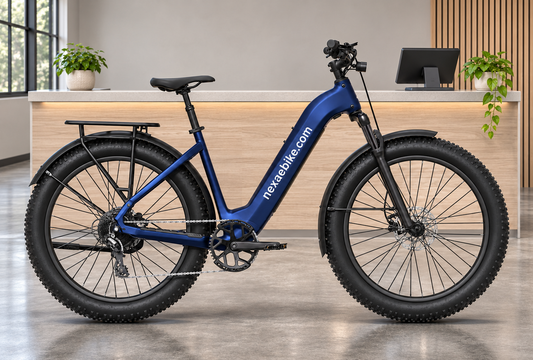
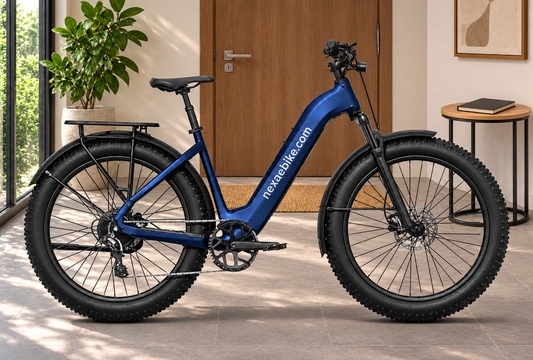
The 750W, 733Wh step-through fat-tire electric bike combines a low-entry frame with 26 × 4-inch tires, an 80mm suspension fork, a suspension seatpost and hydraulic disc brakes. Its listed motor is a rear-hub drive.
It is a candidate for riders who put easy mounting ahead of a high top tube. Before choosing it, compare the Regular and Large fit guidance and measure your storage space. Wide tires and easy entry do not tell you whether you can comfortably move the bike through a narrow doorway or up stairs.
The listing offers torque- and cadence-based assistance through Sensor Switch. Connected ACU features depend on activation, coverage and service terms. Treat connectivity as an extra feature after confirming fit and daily practicality.

2. Changing gradients: compare the drivetrain, not just watts
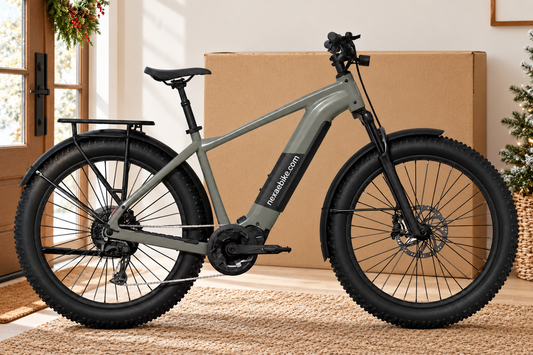
The 100Nm mid-drive fat-tire electric bike with AutoShift pairs a 733Wh removable battery with Shimano CUES 10-speed gearing and electronic automatic shifting. Its listing distinguishes 250W sustained power from 750W peak power; those figures should not be treated as interchangeable.
For a route where you repeatedly change gear, the relevant question is whether automatic shifting suits your riding preferences. Compare the available gearing and assistance controls, rather than assuming that a larger advertised watt figure guarantees a better commute.
This model has 26 × 4-inch tires, an 80mm suspension fork and a suspension seatpost. Its rear frame is rigid, so it is not a full-suspension model. It also has a step-over frame, and the listing states that the throttle is sold separately.

3. Repeated rough patches: decide whether you need rear suspension
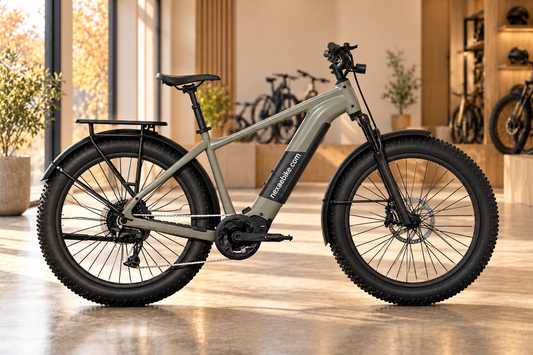
The magnesium-frame full-suspension fat-tire electric bike is listed with front and rear suspension, 24 × 4-inch tires, hydraulic disc brakes and a 48V 20Ah battery. That battery specification corresponds to 960Wh.
Its product description gives a manufacturer-stated 1500W peak motor figure. The description does not establish the sustained rating, so this guide does not use that number to assign a legal vehicle class or claim public-road eligibility.
Consider this option if rear suspension is a specific requirement for your route. Confirm the bike's fit, weight, suspension adjustment and service requirements before ordering. If you mainly ride smooth pavement, compare simpler commuter models too.

Compare the three listed configurations
| Configuration | Battery | Tires | Suspension setup | Main decision |
|---|---|---|---|---|
| 750W step-through hub drive | 733Wh | 26 × 4 inches | 80mm fork and suspension seatpost; rigid rear frame | Low-entry access and rider fit |
| 100Nm mid-drive with AutoShift | 733Wh | 26 × 4 inches | 80mm fork and suspension seatpost; rigid rear frame | Step-over fit and automatic shifting |
| Magnesium-frame full suspension | 960Wh | 24 × 4 inches | Front and rear suspension | Need for rear suspension and service planning |
How much battery capacity does your commute need?
Watt-hours describe stored energy, not guaranteed miles. For a planning example, assume a 20-mile round trip and energy use of 20Wh per mile: 20 × 20 = 400Wh. Under a different assumption of 30Wh per mile, the same trip needs 600Wh. These are illustrative calculations, not tested consumption figures for the bikes above.
Both a 733Wh and a 960Wh battery exceed those illustrative energy totals on paper. That does not establish usable range: assistance level, speed, hills, load, weather, battery condition and tire setup all affect the result. Leave a reserve and confirm charging access rather than planning to arrive with an empty battery.
Bosch's maintenance guidance notes that tire pressure affects e-bike range. Use the bike and tire makers' instructions for your load and setup instead of copying a universal pressure recommendation.
A practical checklist before you choose
- Map the route: record round-trip distance, hills, surface changes and stops.
- Measure the space: check doors, storage, lifts and any carrier you intend to use.
- Check the fit: compare size guidance, saddle adjustment and reach; arrange a fit check where possible.
- Plan ownership: confirm charging, maintenance, parts support and the actual included accessories.
- Verify route access: consult the relevant local authority for the exact vehicle configuration and route before riding.
Prefer a broader comparison? Browse commuter e-bikes, step-through e-bikes or fat-tire e-bikes to compare other frame and tire combinations.
Frequently asked questions
Is a step-through e-bike a good choice for commuting?
It can be a useful choice when easy mounting and frequent stops are priorities. Check the actual size, reach and handling: frame access alone does not establish a comfortable fit.
Are fat tires the same as suspension?
No. Tires and mechanical suspension are different parts of the bike. Wide tires do not replace suspension adjustment, and their width alone does not establish grip on a particular surface.
Does a suspension seatpost count as full suspension?
No. A suspension seatpost cushions the saddle. Full suspension includes front and rear-wheel suspension.
Does a larger battery always mean more range?
It stores more energy when comparing watt-hours, but range also depends on the bike, rider and conditions. Compare capacity alongside the likely demands of your trip.
Which of these models should I shortlist first?
Start with the step-through model if low-entry access is the priority, the mid-drive model if you want to compare AutoShift, or the full-suspension model if rear suspension is a requirement. Then confirm fit, route eligibility, storage and current product details before purchasing.
Editorial note: Specifications are drawn from the linked NexaEbike listings, checked October 28, 2026. This guide does not report independent performance testing. All article images are AI-generated scene illustrations based on listed product images; visible branding has been edited to nexaebike.com. Actual supplied branding and final specifications are shown on the product listings.
Tags:
Related articles

E-Bike Maintenance Records: Build a Service Log
Nov 03 2026

E-Bike Price Tracking: Compare the Same Variant
Nov 02 2026